Sunday, November 17, 2019

Coding & Robotics

Coding and Robotics are two seemingly scary things when being asked to incorporate them
into your classroom, but with the right resources they aren’t so scary after all. Coding is defined as
a precise set of instructions that a computer can understand, almost like a recipe for computers to follow.
Coding is also misunderstood as being a part of science only. Coding can actually be
cross-curricular and be used in math, science, and even English. It allows students to be hands-on,
experience a growth mindset, to collaborate, to improve their confidence with technology, learn
to persist, and learn that failure is a part of the process. Educators can take free coding courses through
code.org. That’s right, FREE! The courses take 6-8 hours to complete and are perfect for getting anyone
started with Coding in their classroom. 
Robotics can go hand-in-hand with coding in the classroom. Students are able to use their
new coding skills to work with robots and create code for moving those robots. Coding and
Robotics challenges students to think analytically and call on their problem-solving skills to embrace
failures and persist through any challenges they may face. Students also learn how to ask good questions,
which will help them within Coding and Robotics but also with their other day to day school lives. 

Hour of Code is now a global movement by Computer Science Education Week and Code.org
that introduces millions of students to computer science and computer programming. Students are
subject to a one-hour intro on these two subjects. Hour of Code really gets students and teachers
thinking about coding and robotics and how it could work within their classrooms. Students that
have never even heard of the two programs could gain interest in a career in coding, robotics,
and other computer science/programming jobs. If you are looking to amplify your STEM/STEAM block
within your classroom, adding coding and robotics can do the trick! Your students will love
it and will grow so much as learners in the 21st century classroom!


Flipped Classroom Model

The Flipped Classroom Model is an approach to teaching that involves students being exposed to
instruction prior to coming to class. The teacher makes a video of instruction and posts it so that students
have access before the next lesson. Students have access to the video at any time and can spend more
class time actually applying the new knowledge. This method is very nontraditional and allows the students
to take over the learning while the teacher acts as a guide. Teachers can choose to present their videos
individually or as a set of modules. The Flipped Classroom Model helps struggling students, increases
teacher-student interactions, works with students of all ability levels, changes classroom management,
educates parents, is a great tool for absent teachers and students, and is compatible with all learning styles. 
Flipped classroom models change classroom management by fostering noise and collaboration. Students
remain engaged and find the flipped model to be fun and remain eager to learn. You have the time and
opportunities to redirect those students that need it and provide additional structure.
There are 8 different variations of the flipped classroom model so it makes it easy to choose which one is
right for you and your classroom! You’ve got the Standard Inverted, Micro Flipped, Discussion Oriented,
Demonstration-Based, Faux-Flipped, Group-Based, Virtual Flipped, and Role Reversal. Many think that if
you teach students who do not have internet access or access to a device at home that you can’t implement
the flipped classroom, but you most definitely can! There is a variation perfect for that situation in which
students access your instructional videos on computers at school before meeting with you in small groups
to discuss, ask questions, and apply that knowledge. 
F - Flexible Learning Environment
L - Learning Culture
I -  Intentional Content

P - Professional Educator


Virtual Field Trips

Virtual Field Trips allow 21st century educators to take our students where the school bus can’t.
Students can visit any location in the world through virtual field trips! They are both fun, engaging, and
allow students to experience things that are not feasible for an actual field trip. Imagine studying about
Egypt with your students. It is very unlikely that you can take your class on a plane all the way across the
world to visit Egypt itself, but students benefit immensely from real experiences and connecting new
knowledge to real world situations. Virtual field trips would make it possible for your students to “visit”
Egypt and take a look around! Not only will students learn the academics, but they will develop an
understanding of other cultures and how other people live around the world. They also attend to students’
social and emotional learning. 
Like most things, virtual field trips have both advantages and disadvantages. Advantages of virtual field
trips include “traveling” to places not possible for a field trip, exploring at the speed of your
students/independently, low cost and often free, safety, enrichment, engagement, and personalized trips
that line up with standards and content. Disadvantages include not being able to replace the actual
human senses, student ability to work with the technology, and internet access. Most of these
disadvantages can be fixed, however. You can bring in things such as food, clothing, and other objects of
the place/culture you are visiting to meet the needs of the 5 senses as you are taking your virtual field trip.
You can also incorporate digital citizenship and use of technology into your curriculum so that students are
familiar and comfortable with the technology that they have access to. Students can always be taught how to
use the technology necessary, and sometimes they know more about it than we do! 
Teachers can choose virtual field trips from an amplitude of resources or even create their own. Skype,
ClassFlow, 360 Youtube, and Google Earth are just a few of the many programs you can use to create
your own experience. Always search, search, and search for experiences that are perfect for you and your
students!


Ed Puzzle and Blendspace

Ed Puzzle is a web app that allows you to take instructional videos and make them into your own. This
app really grasps the concept of 21st century teaching, makes differentiation a breeze, holds students
accountable, and is absolutely free for educators! Ed Puzzle allows teachers to create their own videos to
instruct students and provides all of the necessary tools for editing and assigning these videos for your
students. Teachers also have the option of pulling videos that have already been created to assign to their
students. Ed Puzzle makes differentiation a breeze by giving teachers the opportunity to choose which
students see what videos and even allowing those that need it to view the videos multiple times. This app
enforces accountability by holding students accountable for viewing the videos assigned and coming
prepared to ask questions and apply the new content. Ed Puzzle is perfect for any teacher wanting to
implement a Flipped Classroom Model. 
Blendspace is also a web app that grasps the concept of 21st century teaching and is free to educators.
Blendspace allows teachers to create lessons with your own files and the web, put all of your content in
one place,  and make the most of your class time. Teachers create a lesson and name it, add your standards
and the subject, and then add resources for students to use. Blendspace is compatible with Google Classroom,
Edmodo, and Ed Puzzle. This app is also amazing for anyone wanting to implement a Flipped Classroom
Model. 
Ed Puzzle and Blendspace are not only great for flipped classrooms, but also sub days! Just leave the
information for the sub on how students need to access your videos or lessons and it’s as if students don’t
miss any information at all! Students are still getting the lesson as if you were there and they aren’t made to
complete busy work to ensure they have something to do for the entirety of the teacher’s absence. Teachers
can differentiate, assess, stay organized, and engage students through the use of both Ed Puzzle and Blendspace.
These are great additions to any 21st century classroom!


STEAM in K-2

If you’re in education today, then you’ve more than likely heard all the buzz about STEAM and the push
for embedding it in your everyday classroom activities. STEAM is an educational approach that integrates
Science, Technology, Engineering, the Arts, and Math. It is an important part of students’ learning across all
grade levels, but even more so in the early grades such as Kindergarten through 2nd grade. Many people
have a lot of fear when it comes to STEAM because it involves time, curiosity, problem-solving, and failure.
If we introduce STEAM to students at a young age when they are naturally curious, however, they will develop
their inquiry, discourse, and critical thinking skills. By the time they are introduced to STEAM in the upper
elementary, middle school, and high school classrooms the fear will no longer be there and they will be
able participate in STEAM activities with confidence. 
Young learners are naturally curious about their surrounding environment and naturally develop STEAM
skills such as investigation, exploration, and curiosity through play. Students are engaged in all levels of
learning while doing STEAM. Think about Bloom’s Taxonomy. Students are recalling information, explaining
their investigations, applying new knowledge to a real world situation, making connections, justifying their
explanations, and creating through the Engineering Design Process. The Engineering Design Process takes
students through an entire cycle of planning, testing, analyzing results, and trying again if needed. It teaches
students that failure is okay and that sometimes you run into a problem that you must solve. STEAM sets the
basis for critical thinking, curiosity, and creativity. 

Both the teacher and students have various roles within STEAM inside the classroom. The teacher’s role
includes things such as providing learning opportunities, providing materials that support exploration, and
providing opportunities that support discovery. The teacher must facilitate the learning that is naturally occurring
when students are completing STEAM activities/challenges. The students are responsible for maintaining
perseverance, exploring their natural curiosity, embracing failure, and successfully collaborating with peers
to meet their goal. STEAM prepares students for the real world and opens doors for students to 21st century
careers!


Friday, November 15, 2019

Whole Brain Teaching

Whole Brain Teaching is a method of teaching students that literally uses the "whole brain." The brain is made up of the following areas and each are addressed within WBT:
Visual Cortex: Students see hand gestures throughout the lesson.
Wernicke's Area: Students hear the lesson from start to finish.
Broca's Area System: Students verbalize content as they are learning it.
Motor Cortex: Students are up and moving throughout the lesson.
Limbic: Students' emotional needs are met through positive classroom management strategies.
The goal is whole brain teaching is "to create peaceful classrooms full of orderly fun." This goal is met by using attention getters, engaging students, and management strategies such as the Scoreboard. Attention Getters are call-response chants such as "Class! Yes?" The students must respond in the exact same way that you called them. This ensures that all eyes and ears are on you before moving any further.
WBT engages students by methods such as Mirror Words, Hands and Eyes, Silent Mirror, and Magic Mirror. Mirror with Words has students mirror your hand gestures and words when prompted to do so. Hands and Eyes means that all students should put their eyes on you and have their hands folded in their lap. Silent Mirror is when students mirror your hand gestures but without words. Lastly, Magic Mirror is where students must listen intently so that they can make up their own gestures to match the content. These strategies engage students by allowing them to be active, vocal, and intentional listeners throughout the entire lesson. There are so many other benefits to the whole brain teaching approach. It stimulates and motivates struggling learners, teaches ELL's, and promotes good behavior and physical health. Whole Brain Teaching is "Power Teaching. 


Orton-Gillingham Approach

The Orton-Gillingham Approach is a direct, explicit, multi-sensory, and structured approach for teaching
children to read and spell. This approach first began with Samuel T. Orton and Anna Gillingham. They
created this program with dyslexic children in mind, but ended up creating a method that works for all
children. OG explicitly teaches children the elements of language and facilitates student automaticity in
applying this knowledge when decoding and encoding language. Whole group OG strategies include
things such as tracing, saying the sound, writing, blending, and introducing the new phonogram. Students
then move to their independent practice.
Other strategies include card drills, vowel intensives, letter formation techniques, and decoding of words.
As mentioned before, this approach is multi-sensory so students may be forming these letters with tools
such as sand/salt trays. OG also provides students with visual cues when decoding words. These may be
symbols such as lines, squiggle lines, stars, and other shapes. Each visual cue stands for a specific
sound and helps students to remember what that part of the word should sound like when decoding a word.
Students also participate in a “3 Part Drill.” Part 1 is the visual. Students are exposed to the new phonogram
and will trace the new skill. Part 2 is auditory. Students will be listening to the sound and listening for the
sound in words. Part 3 is blending. Students will now blend words that include the new phonogram.
These drills are to be done 2-3 times per week and should only last about 10-15 minutes. 
OG also has the “Learning a Red Word” strategy. Red words, or sight words, are words that either cannot
be sounded out or words that students do not yet have the skills to sound out yet. This strategy is multi-
sensory because it has students using screen paper, a red crayon, and a red word paper. Students will
trace the red word with the red crayon on top of the screen paper, causing the student to feel the “bumpiness”
of the screen paper as they write each letter. As students trace each letter in the red word they are to say
the letter out loud. This strategy is intended to help students spell red words easily and accurately.
Orton-Gillingham meets the needs of ALL students and enhances any classroom reading block!


Thursday, November 14, 2019

Social and Emotional Learning

Social and emotional learning allows children to develop self-regulation, self-awareness, and interpersonal skills. Children must be able to self manage, become socially aware, build relationships, and make responsible decision to be successful in school, work, and life. Many assume that these social and emotional skills are less important than academic skills such as reading and math, but that is not the case. These interpersonal skills are just as important as their academic skills. Without the ability to self-regulate, make responsible decisions, and maintain relationships, students will not be able to succeed academically. Not only do these skills help students academically, but they also help them socially. Children that experience social and emotional learning are less likely to be bullied due to the fact that they will be able to make more friends. They will have the social and emotional skills needed to maintain friendships. Studies show that 83% of students that have gone through an SEL program improved academically. 11% of students have average gains academically, and 11% of students have a higher GPA. There are many, many strategies to be used to develop students’ social and emotional learning. For Kindergarten, “All About Me” activities, a home living, center, and emotion matching games are great to develop those interpersonal and self-regulation skills. After moving into first grade, you may want to add a read aloud such as “The Pigeon Has Feelings Too” by Mo Willems.
Social and Emotional Learning has “Five Guiding Principles,”
1.Create
2.Integrate
3.Communicate
4.Instruct
5.Empower
 Within my classroom, read alouds will play a major role in my students’ social and emotional learning. Read alouds are great across all grade levels, even the older students. My focus will be on building a community within my classroom with ample opportunities for teamwork and collaboration. I will also encourage positive self-talk and mindfulness through hands-on crafts and activities. For older students, I will provide journals in which they have the freedom to write about whatever they desire with confidence that their work will remain personal and confidential, unless they feel the need to share. Children of all ages need to develop their social and emotional learning inside and outside of the classroom, and I intend on becoming a teacher that holds SEL to a high standard in my classroom.


Tuesday, November 27, 2018

Traditional Literature #2

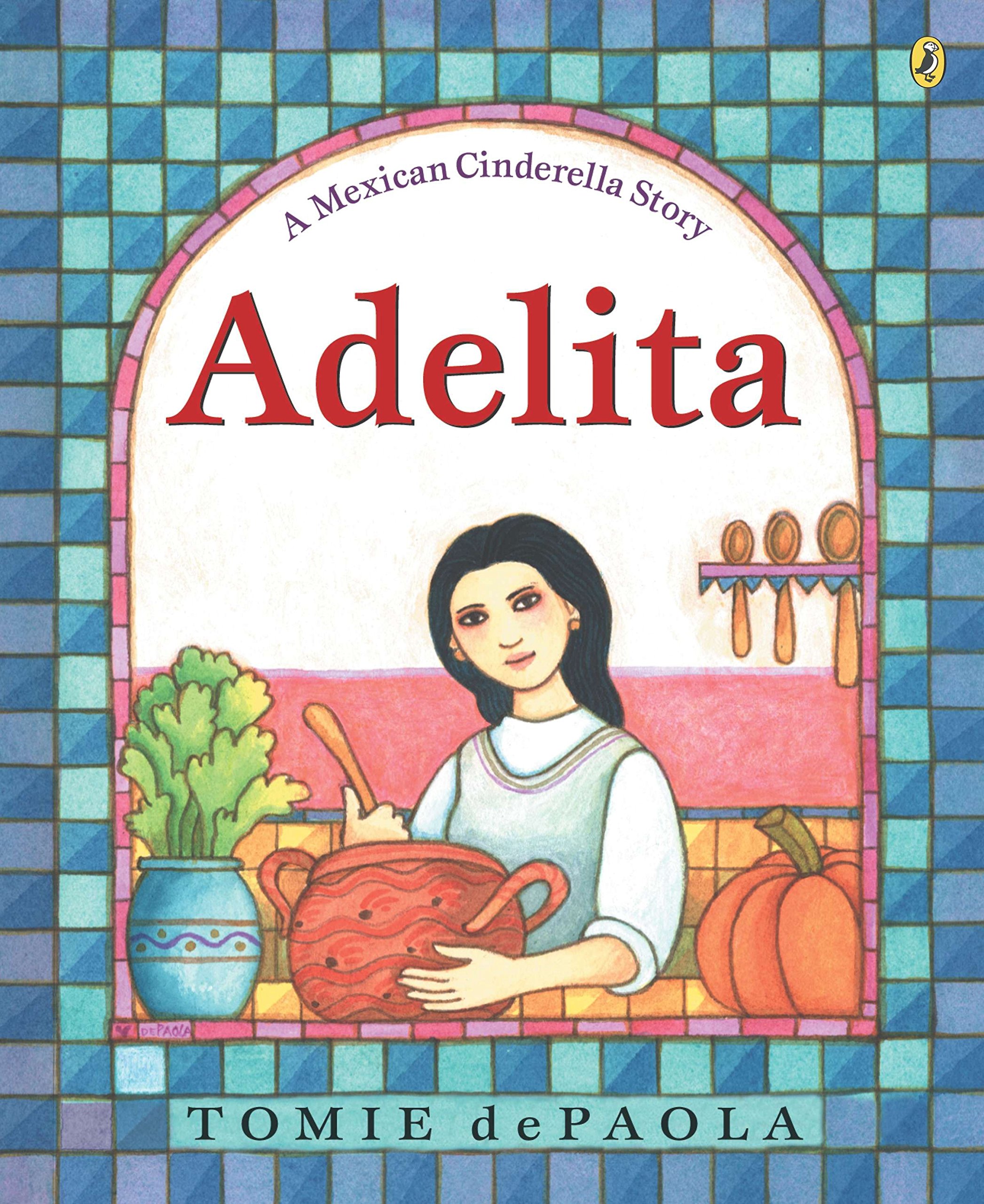
Book Title: "Adelita: A Mexican Cinderella Story"Author: Tomie dePaolaIllustrator: Tomie dePaolaPublisher: Puffin Books, Copyright 2004Number of pages: 40Genre: Traditional Literature

Much like our American Cinderella, a beautiful young girl named Adelita lives with her evil stepmother and stepsisters. There is a young Prince, Javier, that is in search of a wife. Adelita loses her rebozo - shawl - while rushing out of the fiesta at midnight, and this is the only clue that can can help the young Prince find the beautiful Adelita! This is a beautiful Mexican twist on the popular fairy tale we call Cinderella.

dePaola does an exquisite job with the paintings in this story. He really showcases the folk art of Mexico.

Grade Level: KContent Area: 6 ) Compare cultural similarities and differences in individuals, families, and communities.Examples: celebrations, food, traditions

I would do a comparison of both stories, American and Hispanic, of Cinderella. The students could talk about things that are the same and things that are different. This would take quite a bit of prompting from the teacher, but I believe that the kids would enjoy it. This would especially help you connect with your ELL's in the classroom. 

Traditional Literature #1

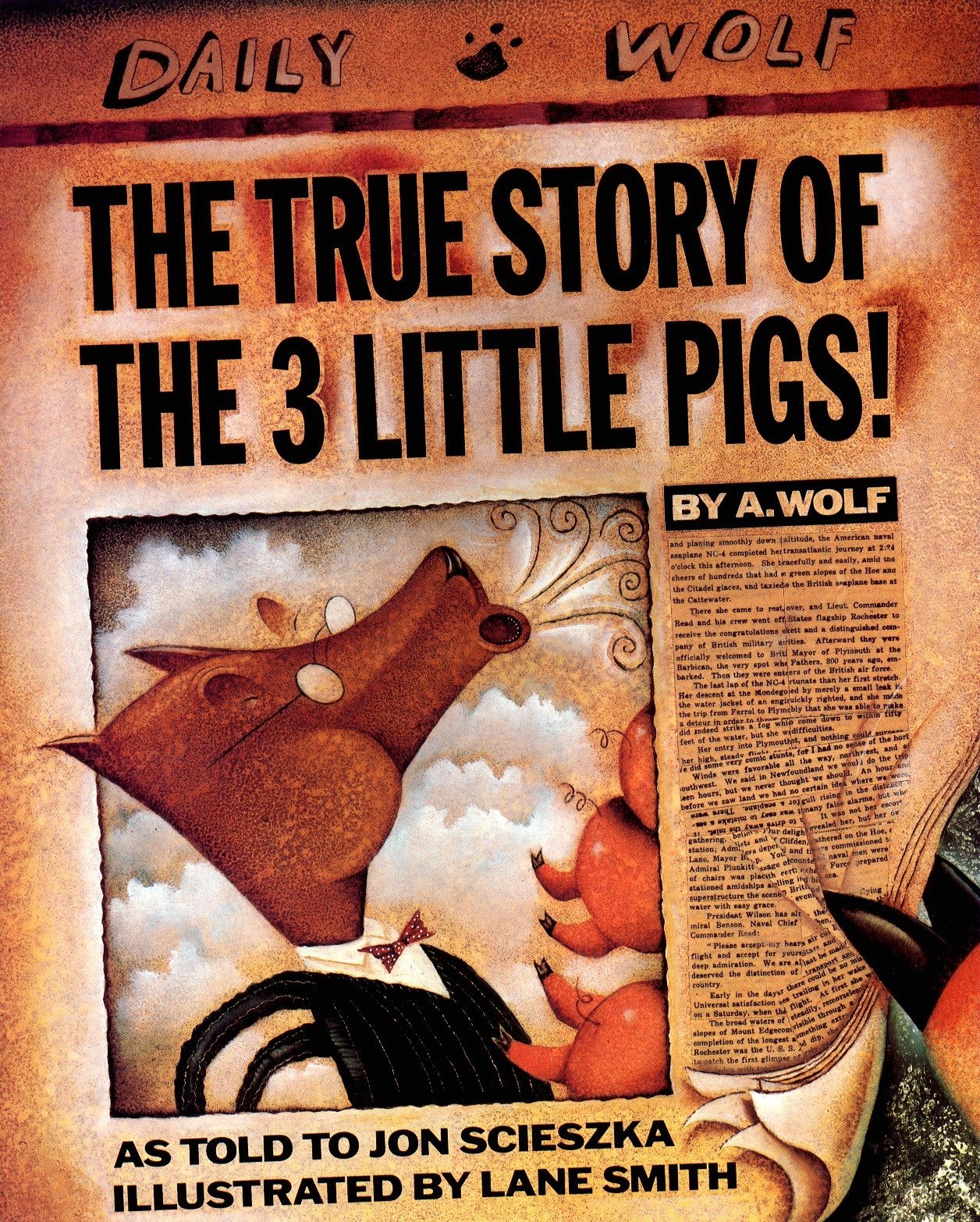
Book Title: "The True Story of the Three Little Pigs"
Author: Jon Scieszka
Illustrator: Lane Smith
Publisher: Puffin Books, Copyright 1996
Number of pages: 32
Genre: Traditional Literature

Just when you think you know the story of the three little pigs...you don't. "The True Story of the Three Little Pigs" is a comical twist on the original fairy tale often told to young children. This particular version is told from the wolf's point of view. It turns out that those three little pigs may not be as innocent as we thought!

The illustrations are very simple and maybe even a little wacky, but they do an awesome job telling the story.

Grade level:1st
Content Area: ELA
Standard: 2) Retell stories, including key details, and demonstrate understanding of their central message or lesson. [RL.1.2]

I chose to use this book with 1st grade because I saw it done in my practicum classroom this semester. I would read the story aloud and then use it for a retell. The students would be able to use retell cards, sticks, or even digital storytelling apps.

Poetry #2

Poem Title: "Dust of Snow"
Author: Robert Frost
Illustrator: N/A
Publisher: London Mercury, Copyright 1020 (Original)
Number of pages: 1
Genre: Poetry

"The way a crow
Shook down on me
The dust of snow
From a hemlock tree

Has given my heart
A change of mood
And saved some part
Of a day I had rued."

Grade level: 5th
Content Area: ELA
Standard: 20) Know and apply grade-level phonics and word analysis skills in decoding words [RF.5.3] 

a. Use combined knowledge of all letter-sound correspondences, syllabication patterns, and morphology (e.g., roots and affixes) to read accurately unfamiliar multisyllabic words in context and out of context. [RF.5.3a]

I would use this for 5th grade as a reading activity. I would introduce the new vocabulary word, "rued," read the poem aloud using different modes of reading (i.e. choral reading and partner reading), and follow up with a class discussion. I would be able to hear them read aloud and listen for fluency in their reading.

Image result for dust of snow robert frost

Poetry #1

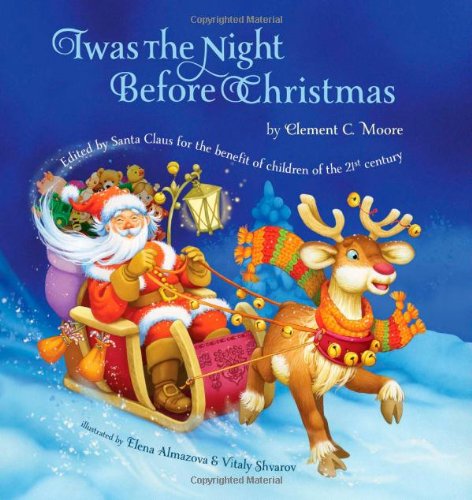
Poem Title: "Twas The Night Before Christmas"
Author: Clement C. Moore
Illustrator: Elena Almazova & Vitaly Shvarov
Publisher: Grafton and Scratch Publishers, Copyright 2013 (Reprint edition)
Number of pages: 32
Genre: Poetry

"Twas the night before Christmas and all throughout the house.." is a classic children's poem about the excitement of Santa making his visits on Christmas Eve night. This is a 21st century edition that is made a little more child friendly for today's young readers.

The illustrations are so much fun and inviting! Almazova and Shvarov did an amazing job providing the pictures for this 21st century version of a very old, but classic children's poem.

Grade level: 2nd
Content Area: ELA (Writing)
Standard: 24) Write narratives in which they recount a well-elaborated event or short sequence of events, include details to describe actions, thoughts, and feelings, use temporal words to signal event order, and provide a sense of closure. [W.2.3]

I would read this with 2nd grade as a read aloud. I would then have them write their own poem about the night before Christmas in their own house. This would allow them to get creative in their writing and practice creating poetry of their own.

Historical Fiction #2

Book Title: The War the Saved My LifeAuthor: Kimberly Brubaker Bradley
Illustrator: N/A
Publisher: Penguin Young Readers Group, Copyright 2016
Number of pages: 352
Genre: Historical Fiction

During WWII, a young girl named Ada has been cooped up in their tiny one bedroom apartment her entire life. Her mother is too embarrassed of her twisted foot to let her go anywhere, but she quickly steals her chance to sneak away. Her brother is going to be shipped out of the country because of the war and Ada finds herself sneaking with him. They meet a woman named Susan and develop such a loving relationship. Will the bond between Susan, Ada, and her brother, Jamie be strong enough to withstand the war?

There are no illustrations, being that this is a chapter book, but the picture on the cover is intriguing! The reader is able to see a little girl staring off in the distance, and the twisted foot that is responsible for keeping her captive.

Grade level: 4th
Content Area: ELA
Standard: 3) Describe in depth a character, setting, or event in a story or drama, drawing on specific details in the text (e.g., a character's thoughts, words, or actions). [RL.4.3]

I would use this in a fourth grade classroom as a read loud. This book may be a little above some of the students' independent reading level, but I feel as though the content would be enriching for them. I would hold discussions with them daily as we read through the book, as well as have them create journal entires to organize their thoughts as we read. After reading the story, I would have them choose a character (Ads, Jamie, or Susan) and analyze them on their own. They would then have the opportunity to create some kind of presentation on the character, digital if they have access to iPads, and then share their presentations with the class. They can also post it to SeeSaw, class Facebook or Instagram pages, or even a class blog.

Monday, November 26, 2018

Historical Fiction #1

Book Title: Bud, Not BuddyAuthor: Christopher Paul Curtis
Illustrator: N/A
Publisher: Delacorte Press for Young Readers, Copyright 1999
Number of pages: 256
Genre: Historical Fiction

Bud, Not Buddy is about a young African American boy that happens to be an orphan during the Great Depression. Bud lives in Flint, Michigan and quickly learns that things will not work in his favor simply because of the color of his skin. He's on a journey in search of his birth father, who he seems to think he's found in a band. Bud learns the true meaning of family and love in this historically rich novel for young readers.

There are no illustrations, but the cover of the book does a great job depicting the main character of the story, Bud.

Grade Level: 5th
Content Area: ELA
Standard: 2 ) Determine a theme of a story, drama, or poem from details in the text, including how characters in a story or drama respond to challenges or how the speaker in a poem reflects upon a topic; summarize the text. [RL.5.2]

I would use this book in a 5th grade classroom for both ELA and a short Social Studies lesson on the Great Depression. The characters, setting, and events could all be compared and discussed throughout the novel. I would read this book with my students aloud daily and hold discussions from there. I would be able to listen to their responses and provide them feedback on the responses they provide, right then and there. 

368468
fj     

Monday, November 19, 2018

Contemporary Realistic Fiction Blog #2

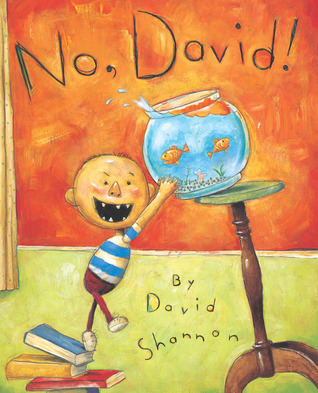
Book Title: "No, David!"
Author: David Shannon
Illustrator: David Shannon
Publisher: Blue Sky Press, Copyright 1998
Number of pages: 32
Genre: Contemporary Realistic Fiction 

When David Shannon was just a young boy, 5 years old to be exact, he just could not stay out of trouble. He broke every single one of his mom's rules. All he ever heard his mother say was, "No, David!" He did everything from showing a mouth full of food at dinner to breaking his mother's vase. He sees at the end, however, that his mother only does it out of love!

The illustrations are so fun and colorful! They are hysterical to look at and do an excellent job of illustrating the events of the story. The reader will always get a kick out David Shannon's accurate picture of David breaking all of the rules.

Grade Level: 1st grade
Content Area: ELA
Standard: 2) Retells stories, including key details, and demonstrate understanding of their central message or lesson.

This would be a great story for retell with 1st grade! They could recount the events that took place in the correct order. They could do this in a number of ways- retell cards, popsicle stick retell with picture clues glued on them, digital storytelling apps, and even through simple discussion.
1062516

Contemporary Realistic Fiction Book Blog #1

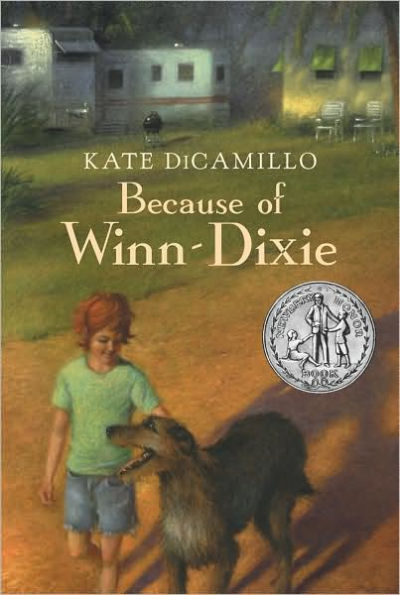
Book Title: Because of Winn-DixieAuthor: Kate DiCamillo
Illustrator: N/A
Publisher: Candlewick, Copyright 2009
Number of pages: 288
Genre: Contemporary Realistic Fiction

One day a young girl named Opal heads down to the grocery store to get some groceries and she stumbles upon a new friend...a dog that she decides to take home and name Winn-Dixie. Winn-Dixie became her very best friend and was the reason for several things- Opal finally made new friends and got the courage to ask her father about her mother that abandoned them when she was just 3 years old. Because of Winn-Dixie, Opal learned true friendship and had the Sumer of her life!

Because of Winn-Dixie is a chapter book, so there are no illustrations. However the cover to the book is so child friendly and inviting. The original publication pictures a little girl walking along with her dog, Opal and Winn-Dixie.
Grade Level: 5th grade

Content Area: ELA
Standard: 2) Determine a theme of a story, drama, or poem from details in a text, including how characters in a story or drama respond to challenges or how the speaker in a poem reflects upon a topic; summarize the text. [RL.5.2]

In my classroom, I would use this to help my students practice determining the theme of a story and summarizing the text. They could do a writing assignment for summarizing the text and publish it on some kind of digital platform when finished. This book could be a part of a Literature Focus Unit in which the students are working with the book in small groups. They would each have a specific job and rotate each day. Within these groups, they can work together to determine the theme of the story.

Wednesday, October 17, 2018

Nonfiction Book Blog #2

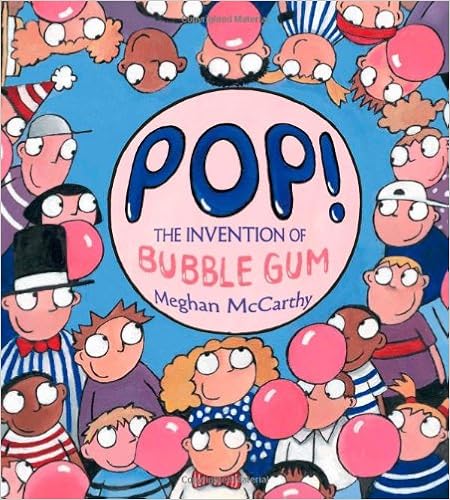
Book Title: "Pop! The Invention of Bubble Gum"
Author/Illustrator: Meghan McCarthy
Publisher: Simon & Schuster/Paula Wiseman Books, Copyright 2010
Number of pages: 40
Genre: Nonfiction

What child doesn't like gum, especially bubble gum? In this fun nonfiction children's book, kids will get to learn the actual history behind bubble gum. They get to learn where it came from, when it came to be, and who is behind the Dubble Bubble Magic.

The illustrations are both fun and engaging! They contain lots of detail and color, which attracts the attention of young children everywhere.

Grade level: 3rd grade
Subject Area: ELA
Standard: 10) Ask and answer questions to demonstrate understanding of a text, referring explicitly to the text as the basis for answers.

This would be such a fun book to use for a Literature Circle! I could have each circle read this book, but they could choose what they want to do with it afterwards. I would simply want them to show me that they can read and comprehend the book, ask each other questions about the book, and answer questions about the book. They could create display board with factual evidence from the book and then present them to the rest of the class.

Nonfiction Book Blog #1

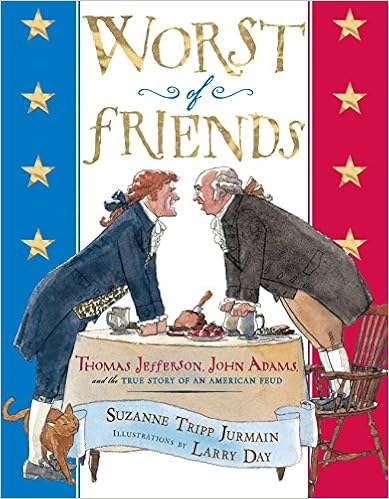
Book Title: "Worst of Friends: Thomas Jefferson, John Adams, and the True Story of an American Feud"
Author: Suzanne Tripp Jurmain
Illustrator: Larry Day
Publisher: Dutton Books for Young Readers, Copyright 2011
Number of pages: 32
Genre: Nonfiction

Two very important figures in American History, Thomas Jefferson and John Adams, just cannot seem to get along when it comes to running the newly created United States. They disagree so much so that they wind up running two opposing political parties, and those disagreements followed them all the way into the White House. Its readers will get to see how these two great presidents chose to put their differences aside and bring back their friendship once again.

The illustrations seem like they could have been done in watercolor. They do a great job at showing the readers different aspects of life in the era of Adams and Jefferson. These aspects include the way that they dress, the way they wore their hair, and even how print used to look compared to what it is today.

Grade level: 4th grade
Subject Area: Social Studies
Standard: 8) Identify major events of the American Revolution, including the battles of Lexington and Concord, Bunker Hill, Saratoga, and Yorktown. 
  • Explaining contributions of Thomas Jefferson,...

I would love to read this book aloud with my students. From there, I would have them pick a side: Team Jefferson or Team Adams. I would give them time to do their research, choose, a side, and determine why they chose that side. I would allow each of them to present their argument. This would be a great opportunity to teach the social studies content, but also to teach them how to debate respectfully.