Tuesday, October 16, 2018

Science Fiction Book Blog #1

Book Title: "If You Decide To Go To The Moon"
Author: Faith McNulty
Illustrator: Steven Kellogg
Publisher: Scholastic Press, Copyright 2005
Number of pages: 48
Genre: Science Fiction

This unforgettable story takes its readers through every step of the journey to travel to the moon. It escorts you through the process of packing, liftoff, landing, and of course how to get home. Readers will learn all about the moon and even get to "land" at the Sea of Tranquility, the site of the first lunar landing.

The illustrations in this story are mind blowing. Kellogg goes into great detail with his pictures of the moon, outer space, the rocket, and everything else that embodies a trip to the moon.

Grade Level: 1st grade
Subject Area: Science (Earth's Place in the Universe)
Standard: 8) Observe, describe, and predict patterns of the sun, moon, and stars as they appear in the sky (e.g., sun and moon appearing to rise in one part of the sky, move across the sky, and set; stars other than our sun being visible at night, but not during the day). 

I would use this book as an introduction into an "Earth's Place in the Universe" unit. As a class, we could take a trip to the moon and use the book to help take us there. From there, we could dive into the other topics mentioned in this standard such as patterns we see in the sun and stars, how they move across the sky, and why we can see other stars at night but not during the day. This unit could very easily take a couple of weeks to complete.
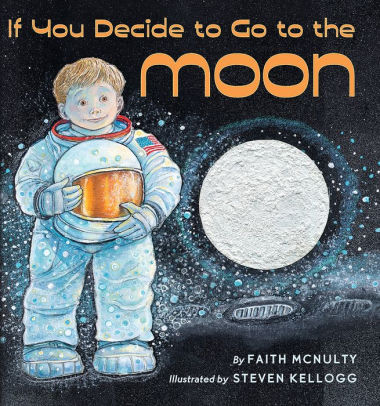
Image result for if you decide to go to the moon

Modern Fantasy Book Blog #2

Book Title: "The Wonky Donkey"
Author: Craig Smith
Illustrator: Katz Cowley
Publisher: Scholastic Paperbacks, Copyright 2010
Number of pages: 24
Genre: Modern Fantasy

Your students will get such a kick out of this hilarious book about a donkey that is quite wonky! He's got three legs, smells terrible, and is so cranky. This will, without a doubt, keep your students engaged and could even be the story that makes them learn to love reading.

The illustrations in this book are hilarious. The pictures in this book do such a great job at allowing the readers to picture the 'wonky donkey' that is bringing them so much laughter and joy.

Grade Level: 1st grade
Subject Area: ELA (Integration of Knowledge and Ideas)
Standard: 7) Use illustrations and details in a story to describe its characters, settings, or events. [RL.1.7]

This is a great book to use to connect the illustrations to the main character, the wonky donkey. They could create their own illustration of the wonky donkey after reading the story with a reading group, and then write a few sentences (3 or 4) describing the donkey that they created.This covers the standard as well as allowing their creative juices to flow.
Image result for the wonky donkey

Modern Fantasy Book Blog #1

Book Title: "How to Teach a Slug to Read"
Author: Susan Pearson
Illustrator: David Slonim
Publisher: Two Lions, Copyright 2011
Number of pages: 32
Genre: Modern Fantasy

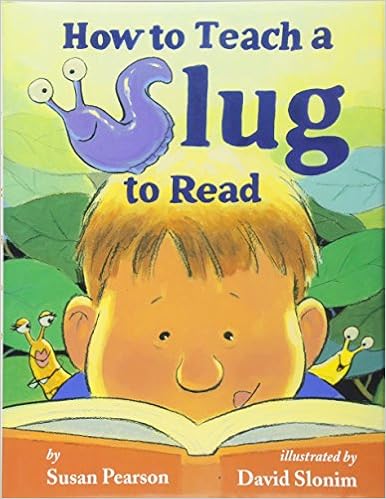
"How to Teach a Slug to Read" is about a young boy who decides he wants to teach a slug how to read. If he can talk, why shouldn't he be able to read? The young boy takes us step by step through the important parts of learning how to read. He tells Mama Slug that in order for Little Slug to learn to read, she should do each of these things: read out loud to him, point out words that repeat, sound words out, make vocabulary lists, and be patient!

Slonim's illustrations are done with acrylics and charcoal, which make for a hilarious representation of Little Slug's journey to reading. They include a lot of color and a great visual representation of each step you should take to learn to read. This can tremendously help your younger readers learn ways to help them to become great readers.

Grade Level: K
Subject Area: ELA (Integration of Knowledge and Ideas)
Standard: 7) With prompting and support, describe the relationship between the illustrations and the story in which they appear (e.g., what moment in a story an illustration depicts.) [R.L.7] 

I absolutely love this book for this Kindergarten standard. You could do a read aloud whole group, hold a grand discussion after, and then break your students into reading groups. In their reading groups, you could assign one "expert" per group. The expert will be the leader of the group and lead the discussions. You could have them talk with their group about how the pictures in the book help tell the story. You could explain to them that illustrations in a story are meant to tell the story along with the words, and that there is a relationship between the words in a story and the illustrations. It's like they help each other!
Image result for how to teach a slug to read

Thursday, October 4, 2018

Diverse Perspectives/International Literature Book Blog #4

Book Title: "Amazing Grace"
Author: Mary Hoffman
Illustrator: Caroline Binch
Publisher: Recorded Books, Copyright 2000
Number if pages: 32
Genre: Fiction

Grace loves acting things out, and she has her heart set on the role of Peter Pan in her school play. Her classmates attempt to discourage her for a number of reasons, but like most grandmothers, Grace's Nana sends her encouraging words and makes Grace realize that she can do absolutely anything that she sets her mind to.

Binch's illustrations in this story are radiant and upbeat. They add a lot of depth and meaning to Grace's story. They appear to be made of watercolor ink, which is gorgeous enough in itself.

Grade level: 2nd grade
Content area: ELA (Craft and Structure)
Standard: 6) Acknowledge differences in the points of view of characters, including by speaking in a different voice for each character when reading dialogue aloud. [RL.2.6]

I would like to break the students into groups and give each group their own copy. I would assign them different characters to be while they read the story aloud together. I would want them to focus on the different view points each of those characters have. After they are all finished , I would want them to present to the class the differences that they found. 

Image result for amazing grace childrens book

Diverse Perspectives/International Literature Book Blog #3

Book title: "Trailblazer: The Story of Ballerina Raven Wilkinson"
Author: Leda Schubert
Illustrator: Theodore Taylor III
Publisher: Little Bee Books, Copyright 2018
Genre: Children's Nonfiction Literature, Biography

This story tells the story of a young African American girl that goes on to become the first black ballerina to perform in a classical ballet. Raven Wilkinson began dancing at the age of 9, and began touring with her first "troupe" in 1955. Raven experienced great racism and discrimination throughout her career, but chose to overcome it all for her love of and passion for dancing.

Theodore Taylor III uses beautiful illustrations, majority line illustrations, that truly bring the story to life. The pictures are extremely vivid and colorful. I believe that students would be very engaged with this text.

Grade level: 3rd grade
Content area: ELA (Literature)
Standard: 3) Describe characters in a story (e.g., their traits, motivations, or feelings) and explain how their actions contribute to the sequence of events. [RL.3.3]

Like many books, this would be great for a read aloud with your students. They could do a follow up discussion with a partner, sometimes referred to a Turn & Talk with younger children, and then share their discussions with the rest of the class. They could discuss Raven Wilkinson and the actions she had to take in order become the strong individual that she was.

Image result for trailblazer the story of ballerina raven wilkinson

Wednesday, October 3, 2018

Diverse Perspectives/International Literature Book Blog #2

Book title: "I'm New Here"
Author/Illustrator: Ann Sibley O'Brien
Publisher: Charlesbridge, Copyright 2015
Number of pages: 32
Genre: Fiction

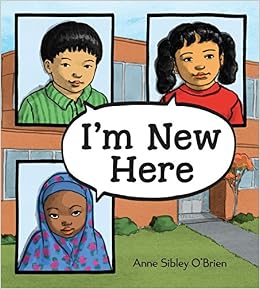
Young immigrants from Guatemala, Somalia, and Korea are struggling to adjust in their new elementary school in the United States of America. There is a huge language barrier between these immigrant students, their peers, and their teachers. However, the school community makes sure that these students are well supported and encouraged. This treatment allows for these young students to build confidence and persevere through this new school year in a new place. They still hold their home language and culture close to their hearts as they become accustomed to their new home.

The illustrations in this story do an excellent job at showing the diversity that comes about within the school. It realistically shows the difference in skin tones that children may see while at school. They are also able to see different dress required by other cultures other than our own. These would be great teachable moments.

Grade Level: 3
Content Area: ELA (Literature)
Standard: 2) Recount stories, including fables, folktales, and myths from diverse cultures; determine the central message, lesson, or moral and explain how it is conveyed through key details in the text. 

This book would be great for a read aloud, especially if you are expecting a new student that may not be from America. I always like discussing the book in whole group to see the reactions about the story and their own perspectives. I believe that breaking them into groups for further discussion and to create something to show that they know the moral of the story using key details from the text would be beneficial. They could create a book blog online and respond to a given prompt. Their book blogs could be on a safe website on which all of their classmates, teachers, and parents could see. They could comment back and forth with each other, debating and discussing what they think the central message is.

Image result for im new here book

Tuesday, October 2, 2018

Diverse Perspectives/International Literature Book Blog #1

Book Title: "Thank You, Mr. Falker"
Author/Illustrator: Patricia Polacco
Publisher: Philomel Books, Copyright 2001
Number of pages: 40
Genre: Autobiographical Story


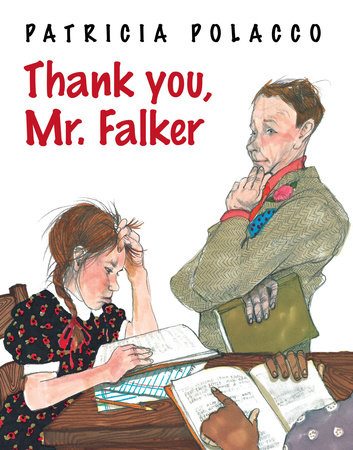
All Trisha dreams about doing is learning. She watches her older siblings go off to school over the years, and she just cannot wait to go herself. However, when she gets there things do not go quite as she planned. Little Trisha struggles learning to read, and is faced with bullies each day at school. School is absolutely miserable for her until she meets her new teacher, Mr. Falker. Like many teachers, Mr. Falker believes in Trisha and forms a very special relationship with her as a student, enabling her to see that school may not be so miserable after all.

Patricia Polacco's illustrations are amazing. It seems as though she is using pens and pencils for this story, which give it a childlike feel. She also does a great job at matching the colors she uses to the tone and emotions that she is trying to convey. When Trisha begins to feel as though she's in a dark place, Polacco makes sure to use darker colors (i.e. the black background).

Grade level: 2
Content Area: ELA (Reading Standards for Literature)
Standard: 3) Describe how characters in a story respond to major events and challenges. [RL.2.3]

For this particular book, I would want to do a read aloud with my students followed with a class discussion. I would want to hear their feelings about the story, talk about different disabilities (including Dyslexia), and discuss with them how important it is to overcome in life. After the discussion, I would love for them to write in their writing journals about Trisha. I might give them a prompt such as, "Trisha faces many challenges throughout the story. Describe those challenges to me and then tell me how Trisha reacts to those challenges."

Image result for patricia polacco illustration medium